Monday, 6 December 2010

Recruitment following 'The Storm'

Shenton bushland has looked distinctly bare this year following the storm; the ground cover plants got shredded, and so, much of the ground cover disappeared leaving the soil bare and exposed to weed invasion.
Having been away for the past few weeks, it was most exciting to walk through the bushland on Sunday and discover millions of sedges (Alexgeorgea nitens, Desmocladus flexuosa) and other shrubs coming up despite the very dry winter. Hopefully they will survive the summer.
John and I went around the western section removing veldgrass that survived the spraying.
I also mapped any lomandra that looked like either maratima or hermaphrodites (hard to tell without the flowering spikes) since these are possible hosts for the endangered sun-moth (symenon gratiosa) that we will be looking for again in March.
Click here to view live map

Click here to download the GPX data for this map. Note, this data is an XML file - change the name to .GPX to upload to your GPS.

Friday, 12 November 2010

Summer Pattern

It felt very familiar returning to our summer weeding pattern - mainly veldgrass, looking out for the occasional Geraldton Carnation weed that has escaped our attention.
Click here to view live map

Click here to download the GPX data for this map. Note, this data is an XML file - change the name to .GPX to upload to your GPS.

Monday, 1 November 2010

Annual Photo Monitoring

Janice Marshall began photo monitoring the bushland in 1994, taking photos in 18 sites around the bushland. We have continued with the monitoring - not every year - but as often as I remember to do so. I did remember to do it this year, and am hoping to find a way to view each of the previous monitoring photos for each site ...

One thing I did notice this year were the unusually prolific grass tree flowering spikes - and the large number of distorted ones. It isn't unusual to find the odd distorted one - but I did find it surprising that there were so many ...
This pair of spikes appear to be dancing with each other ...
This one appears to have tied itself into a knot!
The flowering spikes are the most dominant visual element in the landscape at present. The strange thing is that they don't appear in monitoring photos we have taken in previous years  ... strange.

The photo monitoring sites are shown on the map below.


Click here to view live map

Click here to download the GPX data for this map. Note, this data is an XML file - change the name to .GPX to upload to your GPS.

Saturday, 30 October 2010

Unexpected encounters with a painted lady

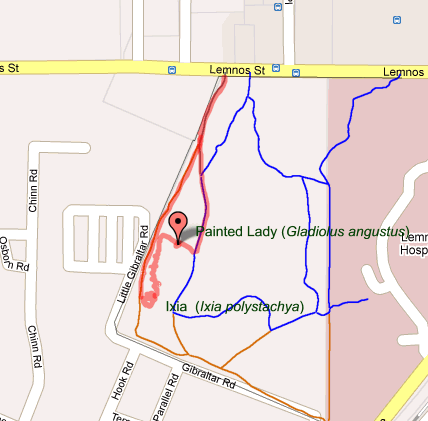
John and I visited the Agave patch, expecting it to be in flower - instead we found painted ladies (Gladiolus angustus) which we embraced with vigour, using our weeding implements to dig them out of the ground (taking care to collect the prolific bulbules they produce). Continuing on with bulbule collection we moved on to the Ixia patch - and found lots there. Our bags became very heavy with soil, so we staggered back to dump our bounty at the bushland entrance.

Long Tubed Painted Lady (Gladiolus angustus) amid an Agave plant

Click here to view live map

Click here to download the GPX data for this map. Note, this data is an XML file - change the name to .GPX to upload to your GPS.

Sunday, 17 October 2010

Summer in Spring

It feels more like late January than early October - hot, dry, humid - this is going to be a really tough summer for the bushland - after a really tough winter that began with a devastating hail storm, and continued with half of our usual rainfall ...

Sunday, 10 October 2010

Nice rain

It was good to get some rain overnight - the bushland looked a bit fresher this morning than last Sunday when it was quite hot - things are very dry, and it isn't even summer yet! The last of the spring flowers are out - swan river myrtle, and summer flowers are coming - ptilotus, fringe lilies.


Swan River Myrtle (Hypocalymma robustum)
John and I worked in the Geraldton Carnation Weed patch(es) along the western fence bordering the Defence Dept land. We found lots .... and there were lots of young GCWs coming up, so we will have to come back here before summer sends them all to seed.
Click here to view live map

Click here to download the GPX data for this map. Note, this data is an XML file - change the name to .GPX to upload to your GPS.

Sunday, 3 October 2010

Blue ladies in flower

Most of the orchids have finished - but the Blue Lady and the Scented Sun Orchid are just flowering now.
John and I worked on a few remaining patches of Geraldton Carnation Weed - one in the Health Department area, the other near the western boundary with the Defence Department.
Dorothy was monitoring Lemandra and the regeneration sites where mounds were removed.

This is a patch of Corynotheca micrantha (sand lily) that used to go right up to the path - died back after spraying by the contractors - it is a bit of a concern that the practice of spraying along the path appears to be creating a 'dead zone' beside the paths - I think we may need to review this practice.

 The scented sun orchid is almost at its peak - I was a bit early for  it to be open this morning.
 The blue lechanaultia are also at peak flowering - very pretty with their intense blue.
 The grass tree spikes are coming up - some amazing sculptural shapes!
 The patch of Agave is almost about to flower - will come back next week to check it.
 The Blue Lady Orchid is also fully in flower now.
Click here to view live map

Click here to download the GPX data for this map. Note, this data is an XML file - change the name to .GPX to upload to your GPS.